Fashion, clothing and textiles, Food & beverage, Furniture
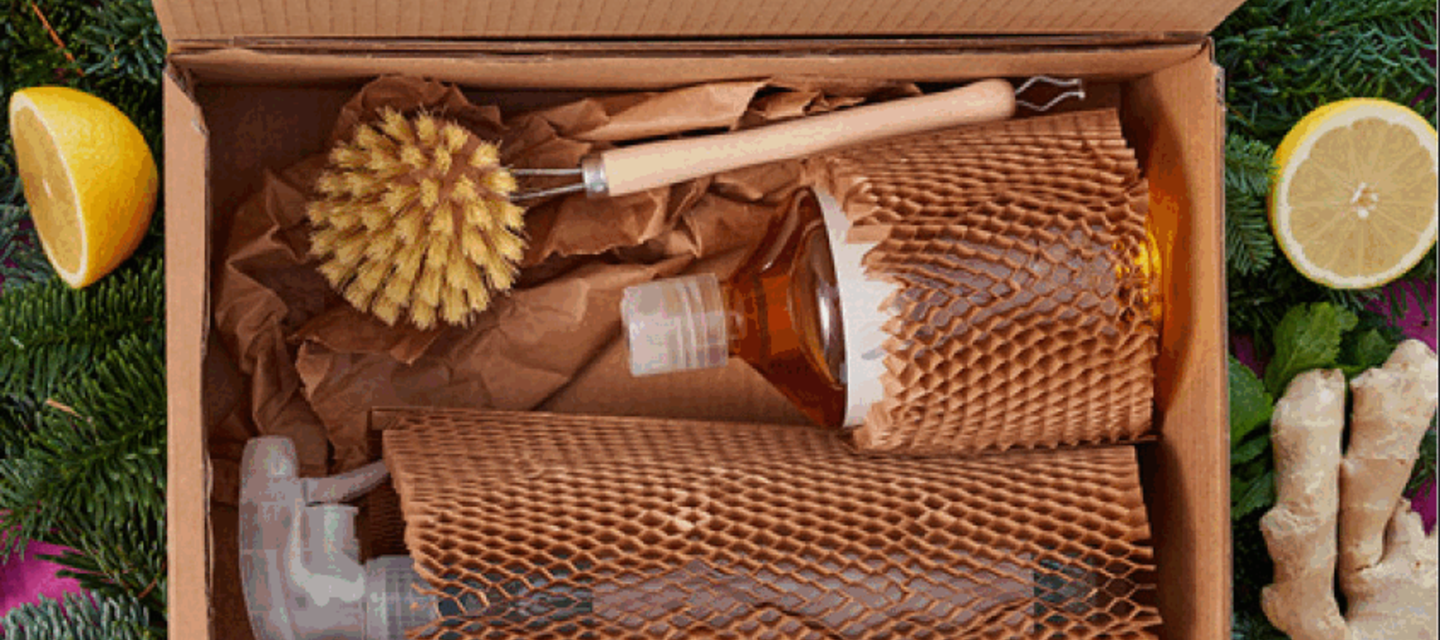
What is it? Flexi-Hex® is a patented technology that creates honeycombed, paper-based protective packaging, meant to replace materials such as polystyrene and bubble wrap in packaging.
Why is this important? Approximately 353 million tonnes of plastic waste is generated every year, and only a small part of this waste stream is recycled (NRDC, 2022). The vast majority of plastics are not part of circular material streams and plastic waste often ends up being incinerated, landfilled or released into the world’s oceans, resulting in major pollution in the form of hazardous chemicals and microplastics (OECD, 2022). This is the case even for bio-based plastics (Nandakumar et al., 2021). Given the scale of the problem and projections that indicate that the global plastic waste stream will continue to grow (OECD, 2022), single use plastics - such as the ones used in protective packaging - are a major environmental concern. By replacing plastic in protective packaging, Flexi-Hex® offers a sustainable and recyclable alternative that avoids adding to the growing problem of plastic pollution (Flexi-Hex, 2026a).
Main resource strategy: Closing the loop by offering recyclable and compostable materials for protective packaging.
Business model aspects:
- Value Proposition: Flexi-Hex® offers recyclable and compostable single use protective packaging, reducing the reliance on plastics, whilst enabling effective protection for products during transportation.
- Value Creation & Delivery: Flexi-Hex® create value by offering protective packaging made from recyclable and compostable materials. The material is built to be strong, flexible and to offer good protection, whilst being light, compact and requiring as little material as possible. This enables space and weight saving packaging that protects products from damage during transport. Flexi-Hex® offers a range of product types and solutions to fit as many products as possible (Flexi-Hex, 2026b).
- Value Capture: Flexi-Hex provides sustainable protective packaging solutions for sellers, meant to displace common plastic alternatives.
Business model experimentation practices: Flexi-Hex® have continued to design new protective packaging solutions to further expand the utility and feasibility of their product. They work together with companies to design and provide viable protective packaging solutions that can be implemented within existing supply chains and product lines (Flexi-Hex, 2026b). They also provide the option of branded designs.
Sustainability outcomes: Flexi-Hex® use exclusively FSC-certified paper (Flexi-Hex, 2026d). They have also commissioned LCAs on parts of their product line, and these have indicated that their Flexi-Hex Air range has a 15% lower carbon footprint than plastic alternatives and that their Mini-Sleeve actually has a 19% higher carbon footprint than a comparable plastic alternative (Flexi-Hex, 2026c). Although the latter LCA was conducted in 2021 (5 years ago at time of writing) and they claim to have made sustainability improvements meant to reduce the carbon footprint, they have yet to conduct a second LCA at time of writing (Flexi-Hex, 2026c).
Sources:
Flexi-Hex. (2026a). Home. Accessed 08 September 2026 at: https://www.flexi-hex.com/
Flexi-Hex. (2026b). Case Studies. Accessed 08 September 2026 at: https://www.flexi-hex.com/case-studies/
Flexi-Hex. (2026c). Why Paper? Report. Accessed 08 September 2026 at: https://www.flexi-hex.com/wp-content/uploads/2025/09/Flexi-Hex-A-Paper-Report.pdf
Flexi-Hex. (2026d). Why FSC Accreditation Matters. Accessed 08 September 2026 at: https://www.flexi-hex.com/insights/why-fsc-accreditation-matters/
Nandakumar, A., Chuah, J., Sudesh, K. (2021). Bioplastics: A boon or bane? Renewable and Sustainable Energy Reviews. 147. DOI: https://doi.org/10.1016/j.rser.2021.111237
NRDC (Natural Resources Defense Council) (2022). Single-Use Plastics 101. Accessed 29 August 2022 at: https://www.nrdc.org/stories/single-use-plastics-101
OECD (2022). Global Plastics Outlook: Policy Scenarios to 2060. OECD Publishing Paris. DOI: https://doi.org/10.1787/aa1edf33-en
***
About project Circular X
Project Circular X is about ‘Experimentation with Circular Service Business Models’. It is an ambitious research project funded by the European Research Council (ERC) which supports top researchers from anywhere in the world. Project CIRCULAR X runs from 2020-2027. The project is led by Principal Investigator (PI) Prof Dr Nancy Bocken, who is joined by a multidisciplinary team of researchers at Maastricht Sustainability Institute (MSI), Maastricht School of Business and Economics, Maastricht University. The project cooperates with businesses who want to innovate towards the circular economy.
Project Circular X addresses a new and urgent issue: experimentation with circular service business models (CSBMs). Examples of such new business models include companies shifting from selling products to selling services and introducing lifelong warrantees to extend product lifetimes. However, CSBMs are far from mainstream and research focused on experimentation is little understood. The research aims to conduct interdisciplinary research with 4 objectives:
- Advancing understanding of CSBMs; their emergence and impacts
- Advancing knowledge on CSBM experimentation
- Developing CSBM experimentation tools
- Designing and deploying CSBM experimentation labs
Funding source
This project has received funding from the European Research Council (ERC) under the European Union’s Horizon 2020 research and innovation programme, grant agreement No. 850159.
Using this information
When you refer to this case, please use the following source:
Circular X. (2026). Case study: Flexi-Hex Paper Packaging Solution. Accessed from www.circularx.eu