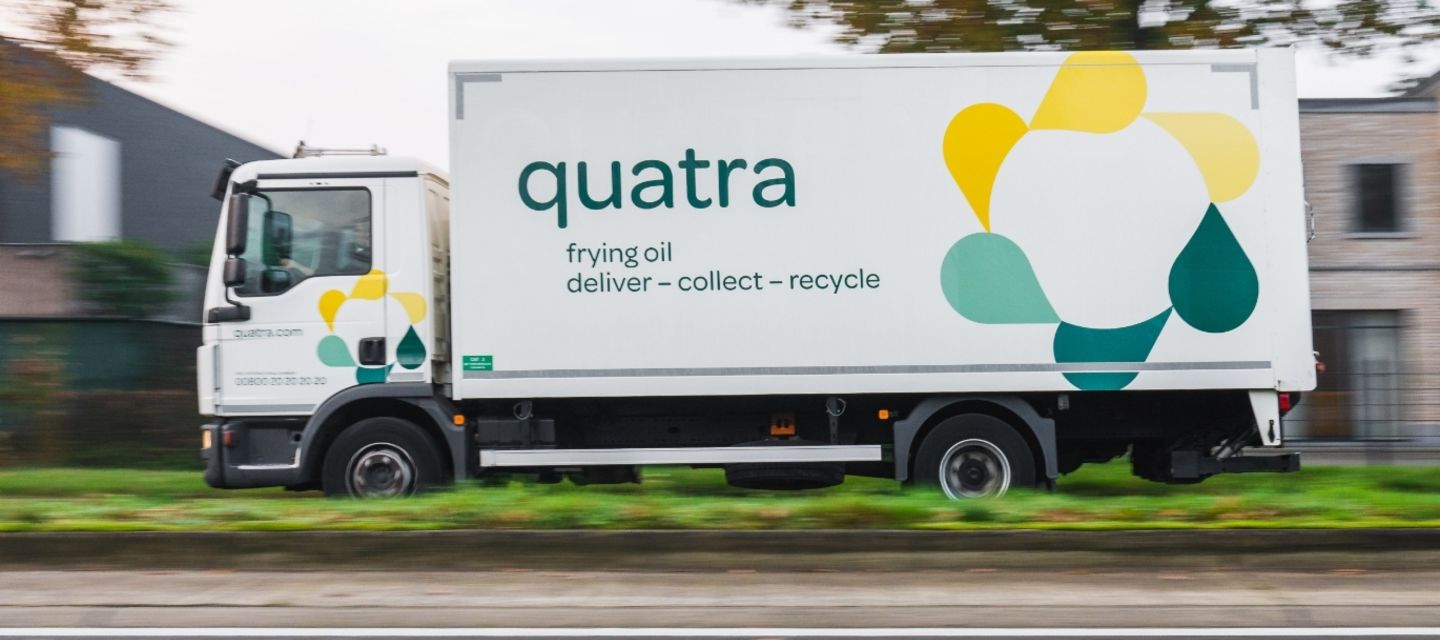
What is it? Quatra collects and recycles used cooking oil and fats from restaurants, hotels, food processors and other businesses into feedstock for biofuels such as biodiesel and sustainable aviation fuel. They are Europe’s largest collector of used cooking oil and serve 180,000 customers over a range of sectors (Quatra, 2026a).
Why is this important? Quatra’s service turns a waste stream into a valuable resource. By collecting and recycling used cooking oil and fat, improper disposal, such as pouring down the drain, is avoided. This is important as doing so can lead to large fines for businesses, and has the potential to create blockages in municipal infrastructure in the form of ‘fatbergs’ that can be very expensive to clear out. One such ‘fatberg’ discovered in London in 2017 was 240m long, and weighed 130 tonnes (Taylor, 2017).
Main resource strategy: Closing & Slowing the loop by recycling used cooking oil into biofuels.
Business model aspects:
- Value Proposition: Quatra collects used cooking oil in various types & packaging, oil based-products that can no longer be sold due to contamination or packaging issues, and oil waste and residues that arise during production. Quatra combines the collection of used cooking oil with the delivery of fresh plant-based frying oil, reducing transport emissions (Quatra, 2026a). The used cooking oil is then used as feedstock into creating sustainable aviation fuel and biodiesel, giving the used oil a second life (Quatra, 2026b).
- Value Creation & Delivery: Quatra ensures collection or delivery of cooking oil within 48 hours, in complimentary sanitized barrels (Quatra, 2026a). Restaurants that use Quatra’s service are able to display CO2 savings certificates that have been created in collaboration with Climate Neutral Group, that give an assessment of the savings made from collecting, transporting, processing and conversion of used cooking oil into usable biofuel (Quatra, 2026b).
- Value Capture: Quatra ensures that customers are supplied with fresh frying oil at the time of collection of the old used frying oil, thereby retaining customers through an efficient supply chain (Quatra, 2026a).
Business model experimentation practices:
- Smart sensor-enabled logistics: Quatra has deployed smart tank sensors (via partners like BrighterBins) in thousands of customer collection points. These sensors monitor oil levels in real time and feed data into dynamic scheduling and route planning systems — reducing unnecessary trips, cutting fuel use, lowering operational costs, and improving service reliability (BrighterBins, 2026).
- Dual-purpose collection routes: Instead of separate trips for delivering fresh oil and collecting used oil, Quatra often combines both services in a single visit, service bundling to reduce CO₂ emissions from transport as well as enhance customer value and resource productivity as part of its circular strategy (Quatra, 2026a).
- Strategic partnerships and long-term supply agreements: The company is experimenting with long-duration feedstock supply deals, such as a 15-year agreement with TotalEnergies to supply 60,000 tonnes/year of used cooking oil for sustainable aviation fuel and biodiesel production (Oil & Fats International, 2025). These types of partnerships extend Quatra’s value chain beyond collection into stable renewable energy markets, helping de-risk investment in circular infrastructure.
Sustainability outcomes: According to calculations done with a third-party – Climate Neutral Group – based on the Greenhouse Gas Protocol, based on the ISO14064, Quatra avoided 322,920 tons of CO2 emissions in 2023. They claim to help cut CO2 emissions of biofuels by upto 87% compared to fossil fuels (Quatra, 2026b).
Sources:
BrighterBins. (2026). How Quatra Transformed Cooking Oil Collection with BrighterBins Smart Sensors. Accessed 02 March 2026 at: https://www.brighterbins.com/projects/quatra-cooking-oil-collection-smart-sensors
Oil & Fats International. (2025). Quatra to supply 60,000 tonnes/year of European used cooking oil to TotalEnergies’ biorefineries for SAF and biodiesel production. Accessed 02 March 2026 at: https://www.ofimagazine.com/news/quatra-to-supply-60-000-tonnes-year-of-european-used-cooking-oil-to-totalenergies-biorefineries-for-saf-and-biodiesel-production
Taylor, M. (2017). ‘Total monster’: fatberg blocks London sewage system. The Guardian. Accessed 02 February 2026 at: https://www.theguardian.com/environment/2017/sep/12/total-monster-concrete-fatberg-blocks-london-sewage-system
Quatra. (2026a). About. Accessed 02 March 2026 at: https://uk.quatra.com/about-quatra
Quatra. (2026b). Sustainability. Accessed 02 March 2026 at: https://uk.quatra.com/sustainability
***
About project Circular X
Project Circular X is about ‘Experimentation with Circular Service Business Models’. It is an ambitious research project funded by the European Research Council (ERC) which supports top researchers from anywhere in the world. Project CIRCULAR X runs from 2020-2025. The project is led by Principal Investigator (PI) Prof Dr Nancy Bocken, who is joined by a multidisciplinary team of researchers at Maastricht Sustainability Institute (MSI), Maastricht School of Business and Economics, Maastricht University. The project cooperates with businesses who want to innovate towards the circular economy.
Project Circular X addresses a new and urgent issue: experimentation with circular service business models (CSBMs). Examples of such new business models include companies shifting from selling products to selling services and introducing lifelong warrantees to extend product lifetimes. However, CSBMs are far from mainstream and research focused on experimentation is little understood. The research aims to conduct interdisciplinary research with 4 objectives:
- Advancing understanding of CSBMs; their emergence and impacts
- Advancing knowledge on CSBM experimentation
- Developing CSBM experimentation tools
- Designing and deploying CSBM experimentation labs
Funding source
This project has received funding from the European Research Council (ERC) under the European Union’s Horizon 2020 research and innovation programme, grant agreement No. 850159.
Using this information
When you refer to this case, please use the following source:
Circular X. (2026). Case study: Quatra - Used cooking oil to biofuel. Accessed from www.circularx.eu