
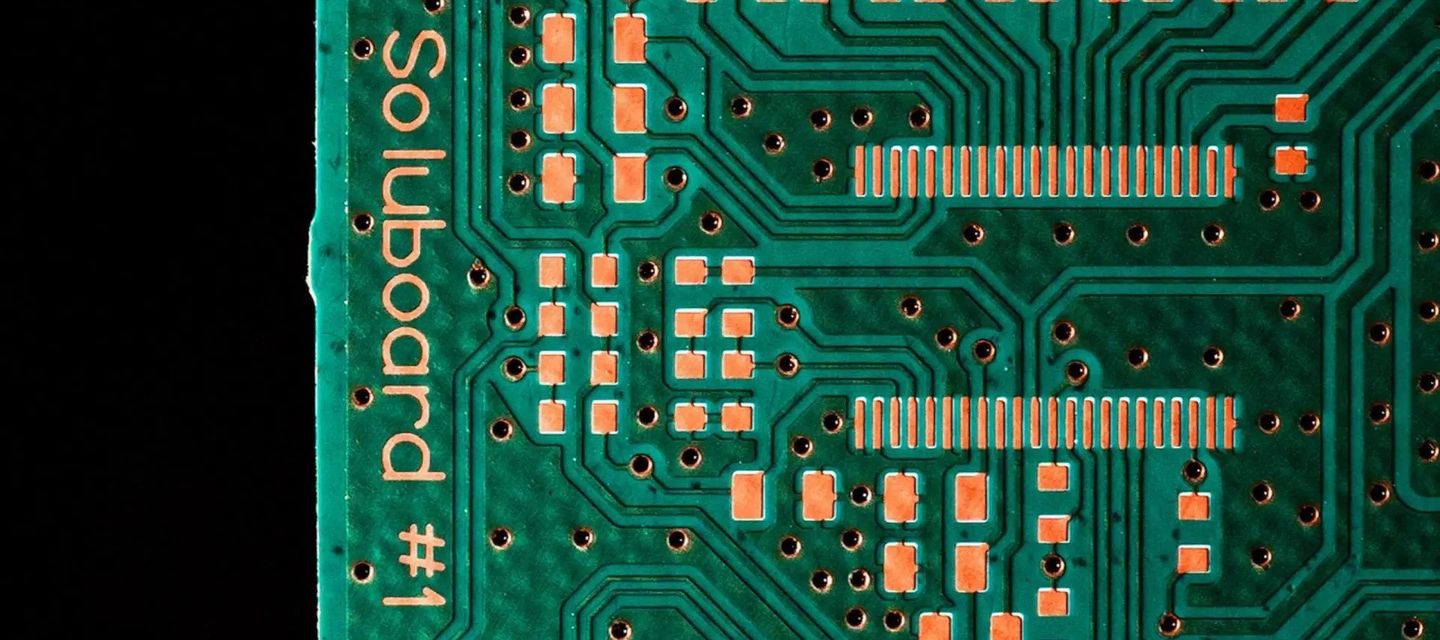
What is it? Soluboard® is a natural fibre-based printed circuit board (PCB) substrate made by Jiva Materials that can replace materials such as plastics in circuit boards. The material itself is fully recyclable, whilst still rigid enough to be used in circuit boards (Jiva Materials, 2026c). The material can be dissolved in hot water for recovery of copper, electronic components containing precious metals and natural fibers.
Why is this important? More than 62 million tonnes of electronic waste is generated globally each year, making it the fastest-growing solid waste stream worldwide (Bladé et al., 2024). This volume is expected to increase to approximately 80 million tonnes annually by 2030 (Bladé et al., 2024). PCBs which are part of all electronics are usually a combination of glass fibre boards, thermoset epoxy resin combined with heavy metals, and valuable rare earth metals. While valuable metals such as copper can be recovered, the glass-fibre and epoxy substrate is difficult to separate and is typically left behind after conventional shredding and recycling processes (Jiva Materials, 2026b). Additionally, hazardous substances can be released into the environment, particularly through informal recycling practices such as the open burning of e-waste to recover valuable metals (Bladé et al., 2024; ILO, 2014). Soluboard addresses this problem by designing the PCB substrate for disassembly and material recovery from the outset. When placed in hot water, the polymer dissolves, allowing copper traces and electronic components to be separated from the natural-fibre substrate. Components can then potentially be reused, while materials that cannot be reused can be directed towards recycling (Jiva Materials, 2026a, d). This not only enables more cost-effective recovery of precious metals and components, but also avoids hazardous recovery practices such as incineration or open air burning.
Main resource strategy: Closing the loop by simplifying the process of recycling, through the use of new material technology. In addition, by using a lower carbon-footprint material, environmental impact is reduced.
Business model aspects:
- Value Proposition: Jiva Materials offers alternative materials that enable more efficient recycling of precious metals and components in electronics, while reducing material footprint and hazardous waste streams.
- Value Creation & Delivery: Jiva Materials create value by offering PCBs with lower weight and material footprint, as well as enabling more efficient recycling processes. Meanwhile, the material is made to withstand industry standard manufacturing processes and to perform to industry standard specifications and the material can be dealt with in existing waste streams. An additional benefit of Soluboard® is that the recycling process enables recovery of more of the metals and components used in PCB, which in turn creates additional value (Jiva Materials, 2026d).
- Value Capture: Jiva Materials capture value by offering the supply of nature-based PCB substrate for technology manufacturing. Given the continued demand for electronics and the projected growth of the PCB waste stream, Soluboard® enables hardware manufacturers to reduce their overall carbon footprint and to meet new standards for carbon footprint reduction
Business model experimentation practices: Jiva Materials are currently attempting to demonstrate that Soluboard® can be integrated into existing product lines and replace the materials currently in use, without the need for major redesigns and changes in manufacturing. They claim that Soluboard has flame-retardant properties and is optimised for etching, electroplating, drilling, routing and other standard PCB fabrication processes (Jiva Materials, 2026b).
Support for upgrade, repair, reuse and recycling: Jiva Materials state that Soluboard® can be dissolved through sustained immersion in hot water, enabling the fibers and metal components to be recovered and recycled.
Sustainability outcomes: Jiva Materials have made calculations and estimates with the aid of the University of Portsmouth, stating that “The raw materials of our natural fibres, biodegradable polymer and halogen-free flame retardant contributes significantly to the reduction in the carbon footprint of a Soluboard® PCB compared to an incumbent PCB. The carbon footprint of one square metre of Soluboard® PCB is estimated to be 5.52kg versus 16.94kg for a traditional PCB. This equates to a carbon footprint reduction of 67% overall.” (Jiva Materials, 2026b,d)
Sources:
Baldé C.P, Kuehr R., Yamamoto, T., McDonald, R., DÁngelo, E., Althaf, S., Bel, G., Deubzer, O., Fernandez-Cubillo, E., Forti, V., Gray, V., Herat, S., Honda, S., Iattoni, G., Khetriwal, D. S., di Cortemiglia, V. L., Lobuntsova, Y., Nnorom, I., Pralat, N., & Wagner, M. (2024). The global E-waste Monitor 2024 – Electronic Waste Rising Five Times Faster than Documented E-waste Recycling: UN. International Telecommunication Union (ITU) and United Nations Institute for Training and Research (UNITAR). Geneva/Bonn
International Labour Organisation (ILO). (2014). The informal economy of e-waste: The potential of cooperative enterprises in the management of e-waste. International Labour Office, Sectoral Activities Department (SECTOR), Cooperatives Unit (COOP) – Geneva: ILO, 2014
Jiva Materials (2026a). FAQs. Accessed 08 September 2026 at: https://www.jivamaterials.com/frequently-asked-questions/
Jiva Materials (2026b). Technology. Accessed 08 September 2026 at: https://www.jivamaterials.com/technology/
Jiva Materials (2026c). Home. Accessed 08 September 2026 at: https://www.jivamaterials.com/
Jiva Materials (2026d). Top 5 Ways Soluboard Reduces E-Waste. Accessed 08 September 2026 at: https://www.jivamaterials.com/top-5-ways-soluboard-reduces-e-waste/
***
About project Circular X
Project Circular X is about ‘Experimentation with Circular Service Business Models’. It is an ambitious research project funded by the European Research Council (ERC) which supports top researchers from anywhere in the world. Project CIRCULAR X runs from 2020-2027. The project is led by Principal Investigator (PI) Prof Dr Nancy Bocken, who is joined by a multidisciplinary team of researchers at Maastricht Sustainability Institute (MSI), Maastricht School of Business and Economics, Maastricht University. The project cooperates with businesses who want to innovate towards the circular economy.
Project Circular X addresses a new and urgent issue: experimentation with circular service business models (CSBMs). Examples of such new business models include companies shifting from selling products to selling services and introducing lifelong warrantees to extend product lifetimes. However, CSBMs are far from mainstream and research focused on experimentation is little understood. The research aims to conduct interdisciplinary research with 4 objectives:
- Advancing understanding of CSBMs; their emergence and impacts
- Advancing knowledge on CSBM experimentation
- Developing CSBM experimentation tools
- Designing and deploying CSBM experimentation labs
Funding source
This project has received funding from the European Research Council (ERC) under the European Union’s Horizon 2020 research and innovation programme, grant agreement No. 850159.
Using this information
When you refer to this case, please use the following source:
Circular X. (2026). Case study: Jiva Materials’s Soluboard® – Recyclable PCBs. Accessed from www.circularx.eu