What is it?
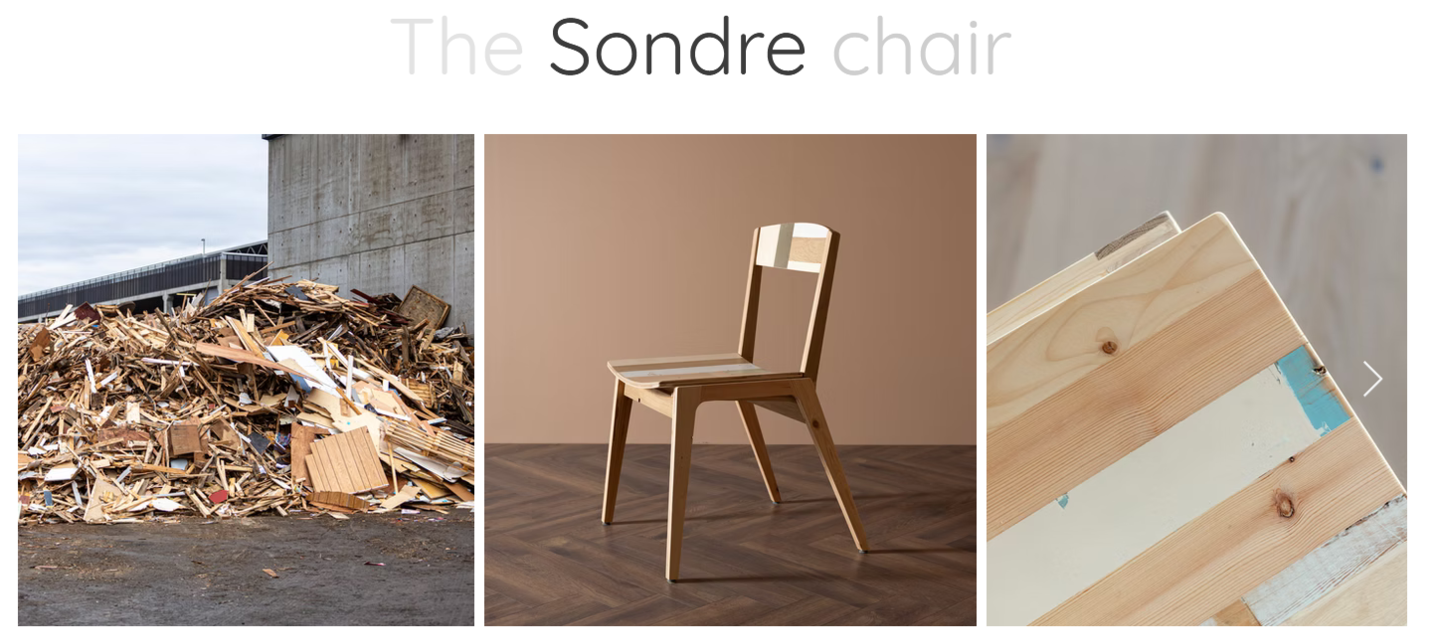
2050 Furniture, designed and developed by the Norwegian company FjordMoods, produces furniture made entirely from reclaimed wood sourced from the local waste stream. Instead of sourcing timber from forests or plantations, the company uses wood that has already completed a first life cycle and is considered structurally low-value in the waste stream (2050 Furniture, 2026).
Its first product, the chair “Sondre,” is currently produced and sold. The chair is made from thin and narrow pieces of reclaimed wood — fragments that would normally be incinerated or downcycled.
The production model is based on a localized industrial symbiosis in Hardanger, Norway:
- BIR, a regional waste management company, supplies reclaimed wood that would otherwise be sent to incineration.
- Hardanger AKS, a work-integration enterprise (a sheltered workplace providing employment for people who need adapted working conditions), performs the labor-intensive sorting, cleaning, metal detection, and preparation of the reclaimed wood.
- After preparation, the wood pieces are laminated — meaning they are glued together into larger structural panels. These panels are then shaped using CNC (Computer Numerical Control) machining. CNC is a digitally controlled cutting process where computer-guided machines precisely mill and shape components from wood panels, ensuring accuracy, repeatability, and scalability.
Rather than building a centralized factory, the company works through a decentralized production model, using existing local infrastructure and industrial partners (2050 Furniture, 2026).
Why is this important?
Similar to the “fast fashion” trend, “fast furniture” is also becoming more prevalent. People replace furniture more frequently, significantly increasing bulky waste (i.e. furniture and large appliances). This trend is due to the recent changes in furniture production and consumption preferences. Manufacturers have focused more on mass production made with less durable materials such as plastic. In the European Union, around 10 million tonnes of furniture waste are discarded each year (European Environmental Bureau, 2017). It is estimated that only 10% are recycled, while the majority is landfilled or incinerated (European Remanufacturing Network, 2015). 2050 Furniture demonstrates a furniture production model that does not rely on virgin timber and integrates social inclusion directly into an industrial value chain. It also uses wood fractions that are considered structurally “worthless,” rather than high-demand species such as oak and ash, while experimenting with short, local supply chains in an industry often characterized by global sourcing.
Main resource strategy
Closing the loop – transforming locally reclaimed wood into finished furniture products.
Other resource strategies
- Narrowing: reducing demand for virgin forest resources by relying exclusively on reclaimed wood (2050 Furniture, 2026).
- Slowing: designing furniture to be repairable, disassemblable, and long-lived, extending the lifespan of wood materials and reducing incineration of usable timber.
Business model aspects
Value Proposition
- For customers: design furniture made from 100% reclaimed wood, produced locally with traceable origin.
- For communities: local value creation through collaboration with regional actors.
- For ecosystems: no direct sourcing from forests or timber plantations.
Value Creation & Delivery
- Collection of reclaimed wood through agreement with BIR.
- Manual sorting, cleaning, and preparation at Hardanger AKS.
- Lamination of small wood pieces into structural panels suitable for industrial processing.
- CNC-based precision cutting to ensure standardized components and efficient assembly.
- Flat-packed delivery and easy assembly/disassembly design.
Value Capture
- Direct product sales to private and project customers.
- Margin between production cost and sales price supporting operational sustainability.
- Replication of local production hubs instead of centralized scaling.
Strategies for degrowth / sufficiency
The company explicitly rejects sourcing from forests — including certified “sustainable forestry” — and instead treats waste as a structural resource opportunity. The design process begins with the available waste material; if a material cannot efficiently support a certain form, the design is adjusted rather than replacing it with virgin resources (2050 Furniture, 2026).
Business model experimentation practices
- Designing around thin reclaimed wood pieces (minimum 8.3 mm thickness, 60 mm width).
- Laminating small fragments into standardized building blocks.
- Exploring Digital Product Passports, which would allow customers to trace the material and production journey via QR codes.
- Working toward Environmental Product Declaration (EPD) documentation to access public procurement and larger B2B markets.
- Developing a modular building block concept intended to enable reuse across product generations.
Tools, methods and approaches used
- Lamination techniques enabling use of mixed and irregular wood types.
- Formaldehyde-free polyvinyl acetate glue for structural bonding.
- Minimal chemical treatment and non-toxic surface finishes.
- CNC machining to combine digital precision with manual recycling work.
- Decentralized hub-based production using existing local actors.
Sustainability outcomes (so far)
- Exclusive use of reclaimed local wood instead of virgin timber (2050 Furniture, 2026).
- Diversion of usable wood from incineration streams.
- Creation of inclusive employment opportunities through Hardanger AKS.
- Establishment of a short, localized industrial symbiosis linking waste management, social enterprise, and industrial processing.
Lifecycle carbon data is currently difficult to quantify, as standard LCA methodologies do not easily account for materials sourced from undefined previous life cycles — a structural challenge the company publicly acknowledges (2050 Furniture, 2026).
References
2050 Furniture. (2026). About. Accessed 02 March 2026 at: https://www.2050furniture.com/
European Environmental Bureau. (2017). Circular Economy Opportunities in the Furniture Sector. European Environmental Bureau: Brussels, Belgium. Accessed 24 November 2021 at: https://eeb.org/library/circular-economy-opportunities-in-the-furniture-sector/
European Remanufacturing Network. (2015). Remanufacturing Market Study; European Remanufacturing Network: Aylesbury, UK. Accessed 24 November 2021 at: https://www.remanufacturing.eu/assets/pdfs/remanufacturing-market-study.pdf
***
About project Circular X
Project Circular X is about ‘Experimentation with Circular Service Business Models’. It is an ambitious research project funded by the European Research Council (ERC) which supports top researchers from anywhere in the world. Project CIRCULAR X runs from 2020-2027. The project is led by Principal Investigator (PI) Prof Dr Nancy Bocken, who is joined by a multidisciplinary team of researchers at Maastricht Sustainability Institute (MSI), Maastricht School of Business and Economics, Maastricht University. The project cooperates with businesses who want to innovate towards the circular economy.
Project Circular X addresses a new and urgent issue: experimentation with circular service business models (CSBMs). Examples of such new business models include companies shifting from selling products to selling services and introducing lifelong warrantees to extend product lifetimes. However, CSBMs are far from mainstream and research focused on experimentation is little understood. The research aims to conduct interdisciplinary research with 4 objectives:
-
Advancing understanding of CSBMs; their emergence and impacts
-
Advancing knowledge on CSBM experimentation
-
Developing CSBM experimentation tools
-
Designing and deploying CSBM experimentation labs
Funding source
This project has received funding from the European Research Council (ERC) under the European Union’s Horizon 2020 research and innovation programme, grant agreement No. 850159.
Using this information
When you cite this publication, please use the following source:
Circular X. (2026). Case study: 2050 Furniture – Upcycling Waste Wood through Industrial Symbiosis and Social Inclusion. Accessed from www.circularx.eu