Food & beverage, Consumer goods
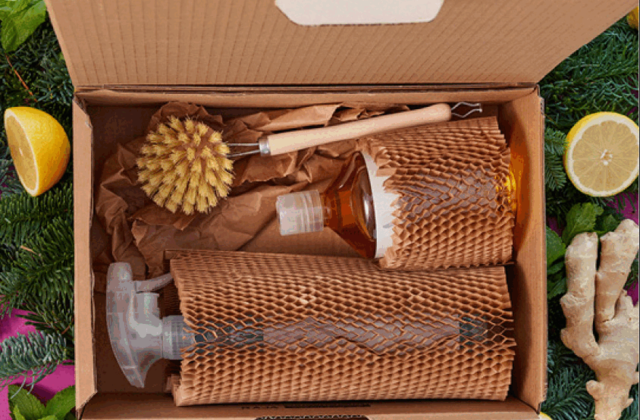
What is it? Set up in 2019, Pieter Pot is a retailer for packaging-free groceries and sustainable products. The business runs an online shop that serves customers in the Netherlands and Belgium, and offers its products packed in large reusable glass and steel jars in selected physical partner stores. It aims to be the “most sustainable online supermarket” (Pieter Pot, 2026a) by making sustainable choices easy.
Why is this important? Pieter Pot addresses several different challenges. The first one is the large amount of single-use plastic packaging that is created through packaging groceries. Dutch households throw away an estimated 3,300 items of plastic packaging every year (Pieter Pot, 2026b). Globally, an estimated 85 per cent of plastics produced end up in landfills (UNEP, 2022). Furthermore, around 98 per cent of these single-use plastic products are produced from fossil fuel, the emissions of which are forecast to grow to 19 per cent of the global carbon budget by 2040 (UNEP, 2022). The second challenge is saving food from being wasted: an estimated 500,000 kg of food is wasted in the Netherlands every year (Pieter Pot, 2026b). Worldwide, about 40% of food produced for human consumption gets lost or wasted, which equates to approximately 2.5 billion tonnes of food (WWF, 2021). Many of those items are perfectly edible but might just not meet the expectations of consumers, for instance in size or shape.
Main resource strategy: Narrowing the loop by avoiding packaging and utilizing reusable containers instead.
Other resource strategies: Closing the loop by offering imperfect items that might otherwise have gone to waste.
Business model aspects:
- Value Proposition: Pieter Pot offers a delivery service for groceries packaged in reusable glass or steel containers. The groceries sold through the store are selected to be sustainable (e.g., organic) where possible (Pieter Pot, 2026d). Some products are furthermore offered in a paper refill as bulk in order to enable refilling at home. In addition to its groceries in reusable glass jars, Pieter Pot introduced a new category of items in 2024: the “verpieter-me-niet” collection (loosely translated to “do not let me go to waste”) which offers products that might have otherwise been wasted. The company works with its suppliers and helps them sell stock that might not be sellable, for instance broken cookies or crackers (Duurzaam Ondernemen, 26.06.2024).
- Value Creation & Delivery: Clients can order their groceries online via the website, with a minimum order of €45. The order is then delivered to them without packaging or in reusable packaging options (Pieter Pot, 2026d). Reusable packaging holds a deposit to encourage customers to return it again when their next order is delivered. Upon return, the delivery driver notes down how much packaging is returned, with the deposit for that packaging added to the customer’s account as credit. Reusable packaging is cleaned and then refilled by the business, with an estimated use of at least 40 times (Pieter Pot, 2026b).
- Value Capture: Revenue is generated through sales of groceries and other sustainable items on offer in the store. Order must be a minimum of €45 to ensure financial viability for the business (Pieter Pot, 2026d). Products in the “verpieter-me-niet” collections are offered at a cheaper price in order to allow affordable shopping to consumers and safe food that would go to waste.
Strategies for degrowth/ sufficiency (based on sufficiency strategies from Niessen & Bocken, 2021):
- Green alternative: Pieter Pot intentionally offers circular and sustainable products to customers, in addition to offering them packaging-free.
- Reuse: Groceries are sold in reusable containers that are returned to Pieter Pot after use with the incentive of a small deposit.
Business model experimentation practices:The business has run several impact collaborations, such as offering fresh food boxes for company Boerschappen to its customers for a trial weekend (Duurzaamn Ondernemen, 26.06.2024). Rather than an intentional experimentation practice, Pieter Pot had to rethink its business after declaring bankruptcy in 2023 (de Groen, 09.08.2024). The company was however saved by a large investment of €1.3 million, including through customer crowdfunding (Duurzaam Ondernemen, 19.12.2024). In March 2024, the business returned and was able to save costs by regaining its previous clients while simultaneously cutting costs in its operations (de Groen, 09.08.2024) and addressing previous customer concerns such as reducing the deposit per glass jar from €2to €1 (de Groen, 26.03.2024). In order to incentivize previous customers to return and ensure that they do not lose money, the company allowed existing customers to retain their saved credit and use it to pay up to 10% of future orders (Pieter Pot, 2025).
Tools, methods and approaches used:To assess the impact of its circular offer, Pieter Pot used a Life Cycle Analysis (LCA) (results below - Pieter Pot, 2026b).
Sustainability outcomes:Pieter Pot conducted an LCA of its circular offer and found that the delivery of a reusable jar produces fewer greenhouse gas emissions than the delivery of a plastic-packaged pack of granola (+20% CO2), a plastic bottle of ketchup (+157% CO2) and a single-use jar of mayonnaise (+32% CO2) (Pieter Pot, 2026b). This is based on the assumption (and experience) that Pieter Pot jars are used at least 40 times. In addition, the company estimates that it has avoided 5,338,932 packaging items through its service by now (Pieter Pot, 2026c).
Sources:
de Groen, T. (26.03.2024). Pieter Pot start door na faillissement: klanten zó enthousiast. De Ondernemer. Accessed 19 May 2025 at: https://www.deondernemer.nl/financien/pieter-pot-start-door-na-faillissement-klanten-zo-enthousiast
de Groen, T. (09.08.2024). Bíjna winstgevend: ineens lijkt toekomst Pieter Pot rooskleurig door deze stappen. De Ondernemer. Accessed 19 May 2025 at: https://www.deondernemer.nl/actueel/pieter-pot-faillissement-jouri-schoemaker-winstgevend
Duurzaam Ondernemen (26.06.2024). Pieter Pot verbreedt zijn impactfocus door samenwerkingen. Accessed 19 May 2025 at: https://www.duurzaam-ondernemen.nl/pieter-pot-verbreedt-zijn-impactfocus-door-samenwerkingen/
Duurzaam Ondernemen (19.12.2024). Pieter Pot: de eerste landelijke verpakkingsvrije supermarkt in Europa die winstgevend is. Accessed 19 May 2025 at: https://www.duurzaam-ondernemen.nl/pieter-pot-de-eerste-landelijke-verpakkingsvrije-supermarkt-in-europa-die-winstgevend-is/
Pieter Pot (16.06.2025). Over het oud tegoed. Accessed 17 November 2026 at: https://pieter-pot.nl/blogs/artikelen/over-het-oud-tegoed
Pieter Pot (2026a). Onze Boodschap. Accessed 17 November 2026 at: https://pieter-pot.nl/pages/onze-boodschap
Pieter Pot (2026b) Onze impact. Accessed 17 November 2026 at: https://pieter-pot.nl/pages/onze-impact-1
Pieter Pot (2026c). Partners. Accessed 17 November 2026 at https://pieter-pot.nl/pages/b2b-partners
Pieter Pot (2026d). Veelgestelde Vragen. Accessed 17 November 2026 https://pieter-pot.nl/pages/veelgestelde-vragen
UNEP (2022). The world is choking on plastics. Accessed on 29th August 2022 at: https://www.unep.org/interactives/beat-plastic-pollution/
WWF (2021). Driven to waste: The Global Impact of Food Loss and Waste on Farms. Accessed 19 November 2021 at: https://wwf.panda.org/discover/our_focus/food_practice/food_loss_and_waste/driven_to_waste_global_food_loss_on_farms/
***
About project Circular X
Project Circular X is about ‘Experimentation with Circular Service Business Models’. It is an ambitious research project funded by the European Research Council (ERC) which supports top researchers from anywhere in the world. Project CIRCULAR X runs from 2020-2027. The project is led by Principal Investigator (PI) Prof Dr Nancy Bocken, who is joined by a multidisciplinary team of researchers at Maastricht Sustainability Institute (MSI), Maastricht School of Business and Economics, Maastricht University. The project cooperates with businesses who want to innovate towards the circular economy.
Project Circular X addresses a new and urgent issue: experimentation with circular service business models (CSBMs). Examples of such new business models include companies shifting from selling products to selling services and introducing lifelong warrantees to extend product lifetimes. However, CSBMs are far from mainstream and research focused on experimentation is little understood. The research aims to conduct interdisciplinary research with 4 objectives:
- Advancing understanding of CSBMs; their emergence and impacts
- Advancing knowledge on CSBM experimentation
- Developing CSBM experimentation tools
- Designing and deploying CSBM experimentation labs
Funding source
This project has received funding from the European Research Council (ERC) under the European Union’s Horizon 2020 research and innovation programme, grant agreement No. 850159.
Using this information
When you cite this publication, please use the following source:
Circular X. (2026). Case study: Pieter Pot – The “most sustainable” online supermarket. Accessed from www.circularx.eu