What is it?
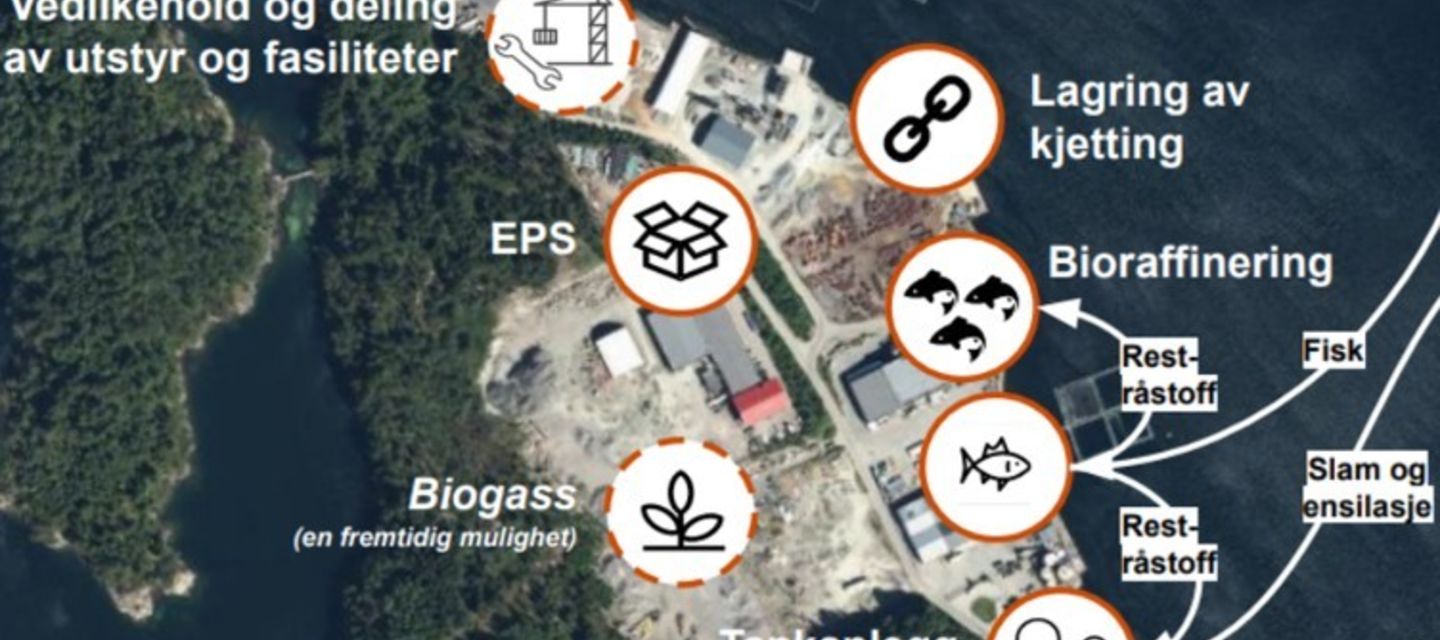
At Skaganeset on Sotra, outside Bergen, several seafood-related companies have co-located: Sekkingstad (salmon slaughter and processing), Biomega (biorefining of fish residuals), BEWI (packaging production), and others, including logistics and waste management partners. Together, they are developing an industrial symbiosis where organic byproducts, energy, and packaging flows are shared across company boundaries.
The collaboration was catalyzed through the Norwegian Seafood Innovation Cluster (NCE Seafood Innovation) and its courses on the circular economy. Sekkingstad took the initiative to connect actors into a joint project exploring sustainable and circular solutions for organic material (iLaks, 2022).
Why is this important?
- Demonstrates how geographical clustering can unlock circular synergies in the seafood value chain.
- Adds value to what was previously treated as waste by upgrading residuals into protein, oil, or local products such as cleaning agents (iLaks, 2022).
- Shows how logistics and packaging can be integrated to cut transport emissions and improve efficiency (Øygarden kommune, 2023).
- Represents a local, business-led transition supported by a cluster organization rather than a top-down policy approach.
Main resource strategy
Closing the loop – capturing fish residuals and processing them into higher-value ingredients rather than discarding them.
Other resource strategies
Narrowing: reducing transport needs through co-location, for example by piping residuals directly to a nearby biorefinery and locating packaging production on site (iLaks, 2022).
Slowing: ensuring resources such as proteins and oils are cascaded into new uses, extending their utility.
Regenerating: reducing environmental load on marine ecosystems by avoiding discharge of organic waste.
Business model aspects
Value Proposition
- For Sekkingstad: reduced waste handling costs and reputational benefits from sustainability initiatives.
- For Biomega: steady access to residual streams for producing human- and animal-grade nutrition (iLaks, 2022).
- For BEWI: local demand for packaging with a reduced transport footprint.
- For society: lower emissions, less waste, and new local value chains.
Value Creation & Delivery
- Shared infrastructure, including underground pipes carrying fish offcuts from Sekkingstad to Biomega (iLaks, 2022).
- Co-location of packaging production and processing facilities, reducing logistics needs (Øygarden kommune, 2023).
- Potential new facilities, such as a biogas plant, to valorize additional organic side streams; these are currently under assessment (Øygarden kommune, 2023).
Value Capture
- Revenues from value-added products such as proteins, fish oils, and packaging.
- Savings from avoided transport, with one estimate indicating a reduction of approximately 44 heavy truckloads per production cycle (iLaks, 2022).
- Potential future revenue from biogas production if planned facilities are realized (Øygarden kommune, 2023).
Strategies for degrowth / sufficiency
By making better use of existing fish biomass, the symbiosis reduces pressure to exploit new resources and encourages cascading use of what is already harvested.
Business model experimentation practices
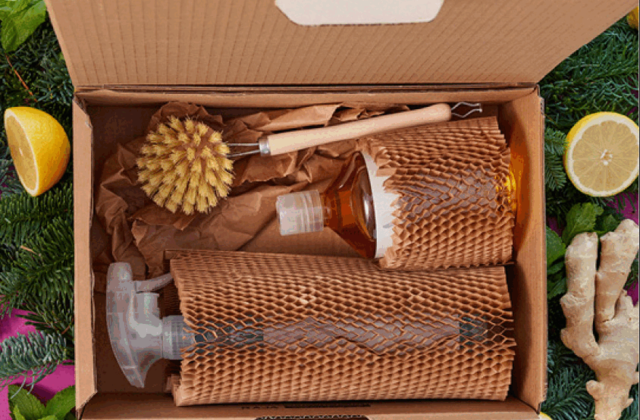
- Early pilot projects, such as converting residuals into local cleaning agents (e.g. Oxitrate and soap) (iLaks, 2022).
- Feasibility studies, supported by Vestland County, for an on-site biogas facility (Øygarden kommune, 2023).
- Iterative expansion, starting with slaughter–biorefinery cooperation and later adding packaging and waste partners.
- Cluster-facilitated workshops and training in circular economy concepts, creating a shared learning ecosystem for participating firms (NCE Seafood Innovation).
Tools, methods and approaches used
- Shared physical infrastructure such as pipes and facilities.
- Cluster collaboration model via NCE Seafood Innovation.
- Feasibility studies and pilot funding for circular projects.
- Cross-company agreements enabling byproduct flows and cost sharing.
Sustainability outcomes (so far)
- Substantial reduction in heavy transport needs, with one source estimating around 44 fewer truckloads per production cycle (iLaks, 2022).
- Fish residuals are processed into proteins and oils at Biomega, increasing value creation from each fish (iLaks, 2022).
- New business opportunities from byproducts, including cleaning products and potential biogas production.
- A strengthened local circular ecosystem, with plans for further expansion such as a biogas plant and additional actors (Øygarden kommune, 2023).
Precise data on volumes, emissions savings, and economic value are still under development and should be tracked as the symbiosis matures.
Sources:
iLaks. (2022). Grønn symbiose på Sotra: Sirkularitet er lønnsomt. Retrieved from https://ilaks.no/gronn-symbiose-pa-sotra-sirkularitet-er-lonnsomt/
Øygarden kommune. (2023). Mulighetsstudie Grønn Hub Vest. Retrieved from https://www.oygarden.kommune.no/naringsutvikling/_f/p79/ib4eef4ae-3be2-4eca-9532-95e6d50c23ea/mulighetsstudie-gronn-hub-vest_230329-1.pdf
LinkedIn. (2022). Industriell symbiose på Skaganeset – historical perspective. Retrieved from https://www.linkedin.com/posts/kathrin-jakobsen-28309a79_visste-du-at-dei-byrja-med-industriell-symbiose-activity-6968270205001039872-Wn_n
***
About project Circular X
Project Circular X is about ‘Experimentation with Circular Service Business Models’. It is an ambitious research project funded by the European Research Council (ERC) which supports top researchers from anywhere in the world. Project CIRCULAR X runs from 2020-2027. The project is led by Principal Investigator (PI) Prof Dr Nancy Bocken, who is joined by a multidisciplinary team of researchers at Maastricht Sustainability Institute (MSI), Maastricht School of Business and Economics, Maastricht University. The project cooperates with businesses who want to innovate towards the circular economy.
Project Circular X addresses a new and urgent issue: experimentation with circular service business models (CSBMs). Examples of such new business models include companies shifting from selling products to selling services and introducing lifelong warrantees to extend product lifetimes. However, CSBMs are far from mainstream and research focused on experimentation is little understood. The research aims to conduct interdisciplinary research with 4 objectives:
-
Advancing understanding of CSBMs; their emergence and impacts
-
Advancing knowledge on CSBM experimentation
-
Developing CSBM experimentation tools
-
Designing and deploying CSBM experimentation labs
Funding source
This project has received funding from the European Research Council (ERC) under the European Union’s Horizon 2020 research and innovation programme, grant agreement No. 850159.
Using this information
When you cite this publication, please use the following source:
Circular X. (2026). Case study: Sekkingstad / Skaganeset – Industrial Symbiosis in Seafood. Accessed from www.circularx.eu