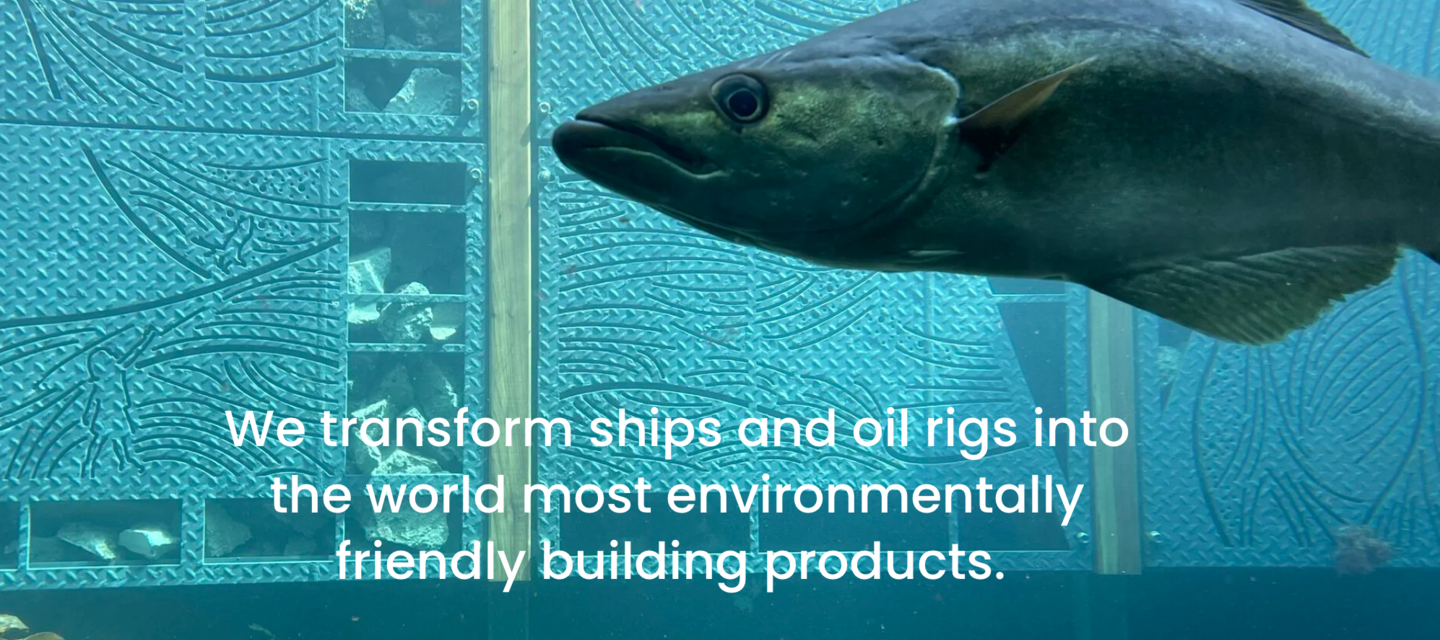
What is it? Nordic Circles is a Norwegian startup pioneering the upcycling of steel from decommissioned ships and offshore structures into certified construction materials. Instead of sending vessels for energy-intensive melting or export, Nordic Circles dismantles and reprocesses ship steel locally, turning it into façade elements, structural components, and other building products. In 2025, the company signed a NOK 1.3 billion agreement with Höegh Autoliners to upcycle eight car carriers into construction steel, with the first dismantling scheduled for 2027 at AF Offshore Decom’s Vats facility (MarineLink, 2024; Kystens, 2025). Nordic Circles operates in collaboration with a broader consortium, Oppsirk, funded partly through Norway’s Green Platform programme (Oppsirk, 2025).
Why is this important? Steel production is one of the most carbon-intensive industries worldwide, responsible for roughly 7–9% of global CO₂ emissions (AF Gruppen, 2024). Traditional ship decommissioning often results in scrap steel being exported for low-value recycling or disposal in landfills (MarineLink, 2024). As CO₂ emissions at end-of-life are largely unpriced, shipowners have limited economic incentives to choose circular decommissioning pathways, even where lower-emission alternatives exist. By upcycling high-quality marine steel directly into new construction products, Nordic Circles addresses two systemic problems simultaneously: reducing waste from end-of-life ships and lowering demand for virgin steel in the construction sector. The model has the potential to transform how steel is handled in Europe, bridging the maritime, demolition, and construction industries.
Main resource strategy: Closing the loop by transforming decommissioned ship steel into high-value construction products.
Other resource strategies: Slowing the loop by extending the life of materials by repurposing existing steel rather than producing new. Narrowing the loop through more efficient use of materials by valorising scrap steel at a higher value level than conventional recycling.
Business model aspects:
1. Value Proposition:
-
For shipowners: sustainable decommissioning pathways that generate economic value rather than disposal costs.
-
For construction actors: access to circular steel with a reported carbon footprint reduction of more than 90% compared to virgin steel alternatives (Oppsirk, 2025; AF Gruppen, 2024).
-
For society: local industrial development, emissions reduction, and reduced export of waste.
2. Value Creation & Delivery:
-
Acquisition and dismantling of end-of-life ships in Norway (MarineLink, 2024).
-
Sorting, cleaning, testing, and certifying marine steel for CE-marked construction use (AF Gruppen, 2024).
-
Delivery of façade plates, structural beams, and other products to architects, builders, and developers (Shifter, 2025).
-
Partnerships with shipowners, yards, engineers, and construction firms enable the new value chain.
Nordic Circles plays a coordinating role in this ecosystem by developing material data, certification processes, and standards that reduce risk and transaction costs across industries (Oppsirk, 2025).
3. Value Capture:
-
Revenue from selling upcycled construction products at a significantly higher value (reported up to ~10×) than scrap steel (Oppsirk, 2025).
-
Long-term supply agreements (e.g., the Höegh Autoliners eight-ship deal) (MarineLink, 2024; Kystens, 2025).
-
Public funding and recognition (Green Platform; Gründerprisen 2025) (Sirk Norge, 2025).
Strategies for degrowth / sufficiency:
- Reuse: The model reduces demand for virgin steel production and promotes sufficiency by reusing existing resources at scale, in line with climate mitigation goals (AF Gruppen, 2024).
Business model experimentation practices:
-
Pilot projects such as “Superdock”, where ship steel is used in floating structures that also function as marine habitats (Oppsirk, 2025).
-
Iterative testing and certification of ship steel for building applications (AF Gruppen, 2024).
-
Establishment of the Oppsirk consortium to align actors across industries (Oppsirk, 2025).
-
Large-scale proof-of-concept through the Höegh Autoliners partnership (eight vessels), with phased implementation timelines reflecting the complexity of first-of-a-kind industrial coordination (MarineLink, 2024).
Public support is used on a temporary basis to enable first-of-a-kind coordination and learning across the value chain, rather than to subsidize ongoing operations (Oppsirk, 2025).
Tools, methods and approaches used:
-
Material testing and CE-certification processes (AF Gruppen, 2024).
-
Cross-industry collaboration across shipping, decommissioning, steel processing, and construction.
-
Environmental life-cycle assessments to estimate CO₂ reductions (Oppsirk, 2025).
-
Public funding instruments (Green Platform) enabling scaling and risk-sharing (Oppsirk, 2025).
Sustainability outcomes:
-
Estimated CO₂ savings of approximately 100,000 tonnes from the Höegh Autoliners project alone (MarineLink, 2024; Kystens, 2025).
-
Upcycled steel reported to reduce carbon footprint by >90% compared to virgin steel production (Oppsirk, 2025; AF Gruppen, 2024).
-
Retention of material quality while avoiding high-energy remelting processes (AF Gruppen, 2024).
-
Development of local green industry and employment in circular construction value chains (Shifter, 2025).
-
National recognition: awarded Gründerprisen 2025 for pioneering a circular steel business model (Sirk Norge, 2025).
Sources:
Nordic Circles. (2025). Homepage. https://www.nordiccircles.com/
(2025). About Oppsirk. https://www.oppsirk.no/
(2025). Kjøper utrangerte skip for én milliard – og gir stålet nytt liv.https://www.kystens.no/nyheter/kjoper-utrangerte-skip-for-n-milliard-og-gir-stalet-nytt-liv/2-1-1827548
(2025). Oppstartsselskap leverer gjenbrukt skipsstål til nye bygg.https://www.shifter.no/nyheter/opptartsselskap-leverer-gjenbrukt-skipsstal-til-nye-bygg/353426
Sirk Norge. (2025). Nordic Circles vant Gründerprisen 2025. https://www.sirknorge.no/nyheter/nordic-circles-vant-grunderprisen-2025
AF Gruppen. (2024). Will future building materials be made of recycled steel from old ships and oil platforms?https://www.afgruppen.com/news/2024/will-future-building-materials-be-made-of-recycled-steel-from-old-ships-and-oil-platforms/
(2024). Höegh Autoliners, Nordic Circles partner on ship upcycling.https://www.marinelink.com/news/hegh-autoliners-nordic-circles-partner-526454
***
About project Circular X
Project Circular X is about ‘Experimentation with Circular Service Business Models’. It is an ambitious research project funded by the European Research Council (ERC) which supports top researchers from anywhere in the world. Project CIRCULAR X runs from 2020-2027. The project is led by Principal Investigator (PI) Prof Dr Nancy Bocken, who is joined by a multidisciplinary team of researchers at Maastricht Sustainability Institute (MSI), Maastricht School of Business and Economics, Maastricht University. The project cooperates with businesses who want to innovate towards the circular economy.
Project Circular X addresses a new and urgent issue: experimentation with circular service business models (CSBMs). Examples of such new business models include companies shifting from selling products to selling services and introducing lifelong warrantees to extend product lifetimes. However, CSBMs are far from mainstream and research focused on experimentation is little understood. The research aims to conduct interdisciplinary research with 4 objectives:
-
Advancing understanding of CSBMs; their emergence and impacts
-
Advancing knowledge on CSBM experimentation
-
Developing CSBM experimentation tools
-
Designing and deploying CSBM experimentation labs
Funding source
This project has received funding from the European Research Council (ERC) under the European Union’s Horizon 2020 research and innovation programme, grant agreement No. 850159.
Using this information
When you cite this publication, please use the following source:
Circular X. (2026). Case study: Nordic Circles - Upcycling steel for construction. Accessed from www.circularx.eu